.png?width=200&height=100&name=FJ%20white%20colour%20(400%20x%20200%20px).png)
The FourJaw automated production count records how many parts your machines or lines produce. This allows you to report on production quantities by shift, day or machine.
Hardware required
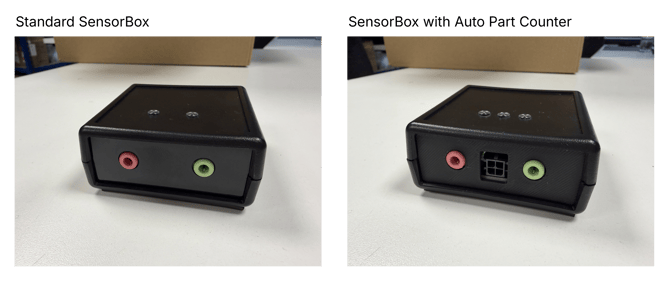
A standard FourJaw installation uses two current clamps connected to a SensorBox to monitor whether your machine is running.
For automated production count, we will ship you an alternative SensorBox which includes an additional counting input.
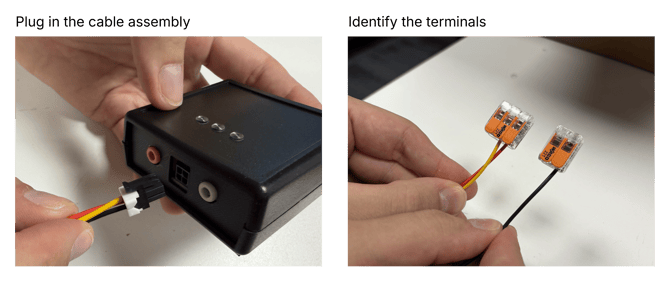
We'll also ship you a cable assembly that plugs into this input using a connector. On the other end of the cable assembly are two quick-connect terminals.
How products are counted
Each time the two terminals are momentarily connected, FourJaw registers one part produced.
A common setup uses a relay inside the machine’s electrical cabinet. The machine briefly closes this relay whenever it completes a part. This connects the two terminals and sends a pulse to FourJaw.
The counter requires a volt-free contact, sometimes called a dry contact. Do not apply an external voltage to the FourJaw counter wires.
Wiring diagram
Download the wiring diagram by clicking here.
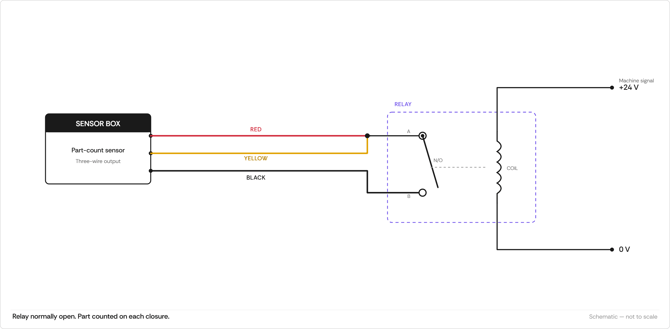
This diagram shows how the FourJaw automated counter connects to the normally open contacts of a suitable relay.
When the relay closes:
- The two FourJaw counter wires are connected.
- The SensorBox detects a pulse.
- FourJaw records one completed part.
All electrical work should be completed by a suitably qualified person and in accordance with the machine manufacturer’s guidance.
Production lines
For a production line, counting is normally triggered by a sensor that detects each finished item passing a specific point.
The sensor should be configured to operate a relay so that:
- The relay closes momentarily when a completed item passes.
- The relay produces only one pulse for each completed item.
- The relay provides a volt-free contact for the FourJaw counter.
The sensor should be positioned where it detects finished products reliably without counting the same item more than once.
CNC machines
On a CNC machine, the counting pulse can often be triggered from the part program using a programmable M-code or another machine output.
A typical setup works as follows:
- The CNC reaches the end of a completed part cycle.
- The part program activates a suitable machine output.
- That output momentarily closes a relay.
- FourJaw records one completed part.
Some CNC machines may already operate a relay at the end of a cycle, potentially when M30 is executed. However, this behaviour is machine-specific: M30 normally ends and resets the program, but it does not universally provide a usable counting output.
If a suitable output is not already available, a machine tool engineer or controls engineer may need to configure an output through the CNC controller or PLC.
Before connecting the counter
Please confirm that:
- The chosen signal occurs once per completed part.
- The relay provides a volt-free, normally open contact.
- No voltage will be applied to the FourJaw counter wires.
- The pulse is brief and does not remain permanently closed.
- The installation has been checked by a suitably qualified person.
If one machine cycle produces several parts, FourJaw can be configured with an appropriate counting multiplier.