.png?width=200&height=100&name=FJ%20white%20colour%20(400%20x%20200%20px).png)
OEE identifies the percentage of manufacturing time that is productive. An OEE score of 100% means you are manufacturing only good parts (100% Quality), as fast as possible (100% Performance), with no downtime on the machine (100% Availability). It is used by many manufacturing companies as a key metric to understand the operational performance of the shop floor.
What does OEE measure?
OEE isn't a single figure, it is made up of three components that you multiply together:
OEE = Availability × Performance × Quality
Each component measures a different type of loss:
- Availability — how much of your planned production time your machine was actually running
- Performance — how fast your machine ran compared to its ideal speed
- Quality — how many of the parts produced were good (not scrapped or reworked)
To get a true OEE score, you need all three components. Some manufacturers start with just one or two — that's a perfectly valid approach. FourJaw can help you measure each component incrementally as you build towards a full OEE solution.
As a benchmark, 60% OEE is the average across manufacturers in different industries. World-class OEE is considered to be 85% or above.
Why calculate OEE by component?
Calculating a single OEE figure alone doesn't tell you how to improve it. Each component has different causes and different methods of improvement. Understanding where your losses are is the key to fixing them.
For example, if your OEE is 60%, you need to know: is that because of machine downtime, slow cycle times, or poor quality? The answer completely changes what action you take.
OEE is also most useful when applied to specific machines or cells. When used across larger groups of machinery, it becomes less valuable because it doesn't give you good visibility into what caused the losses.
How Does FourJaw Calculate OEE?
Availability %
Availability measures actual uptime as a percentage of planned production time.
Formula: Availability = (Uptime ÷ Planned Production Time) × 100
Example: If a machine has 3.5 hours of planned production time, and was actually running for 2.5 hours, Availability = (2.5 ÷ 3.5) × 100 = 71.43%
Any downtime during Planned Production Time counts as an Availability loss, whether it's a necessary part of production or not.
Performance* %
*Performance is not currently measured in FourJaw
Performance measures how fast your machine runs compared to its ideal cycle time.
Formula: Performance = (Ideal Cycle Time × Total Parts Produced ÷ Total Time) × 100
Example: 1.8 × 10 ÷ 20 = 0.9 × 100 = 90%
Quality
Quality measures the proportion of parts produced that were good.
Formula: Quality = (Total Good Parts ÷ Total Parts Produced) × 100
Example: 1638 ÷ 1788 = 0.916 × 100 = 91.6%
What is Planned Production Time?
Planned Production Time is a critical concept for calculating Availability accurately in FourJaw. It refers to the time you intend your machine to be productive — and it's not always the same as your shift time.
For example, if your staff attend pre-shift briefings, safety meetings, or need time to set up the machine, that time is part of the shift but may not be part of Planned Production Time.
In FourJaw, you can set Planned Production Time separately from your shift time. The Availability metric then only counts downtime that occurs within your Planned Production Time window.
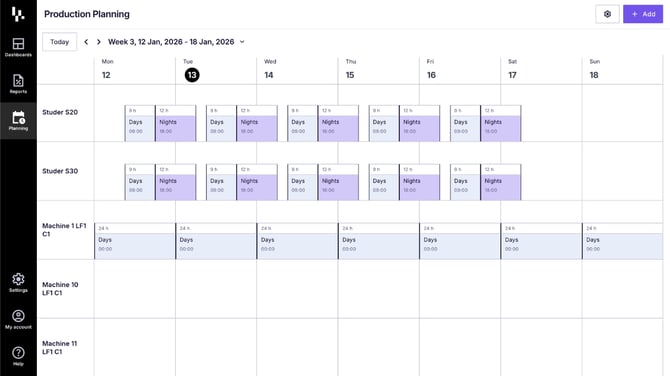
Planned Production Time can be configured separately from your shift time in FourJaw's Production Planning settings
How to measure Availability in FourJaw
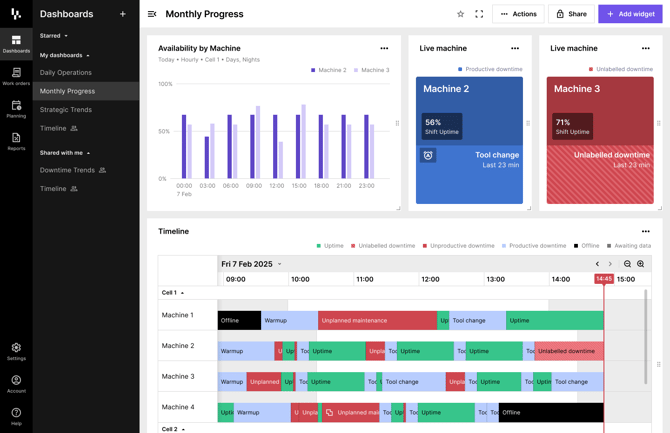
FourJaw gives you three dedicated Uptime widgets to track your Availability metric across your machines. You'll find these in the widget library under the Uptime section.
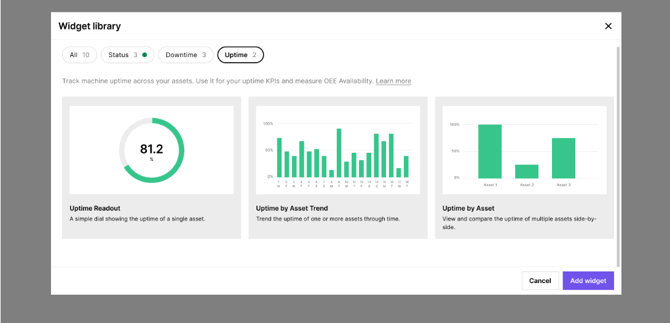
The widget library shows the three Uptime widgets under the Uptime section — use these to measure and monitor Availability
Uptime Readout
A simple dial showing the uptime of a single asset. Ideal for a focused view of one machine's Availability at a glance.
Uptime by Asset Trend
Trend the uptime of one or more assets through time. Use this to track whether your Availability is improving over days or weeks.
Uptime by Asset
View and compare the uptime of multiple assets side-by-side. Perfect for identifying which machines have the lowest Availability and where to focus your improvement efforts.
Tracking downtime on the operator interface
One of the most powerful ways FourJaw helps you improve Availability is through downtime tracking on the Operator Interface. When a machine stops, operators can log the reason directly from the screen — giving you accurate, real-time data on what's causing your Availability losses.
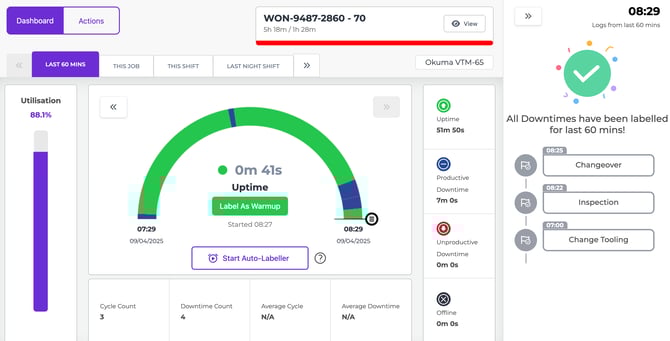
The operator interface shows current machine status, downtime duration, and logged downtime reasons — giving your team everything they need to record losses accurately
When all downtimes are labelled, you have the data you need to understand your Availability losses and take targeted action to reduce them.
Viewing Quality in Reports
FourJaw's Production Quantity Report gives you a broader view of quality data across all your jobs and references — showing total good quantity, scrap quantity, and quality percentage across machines and time periods.
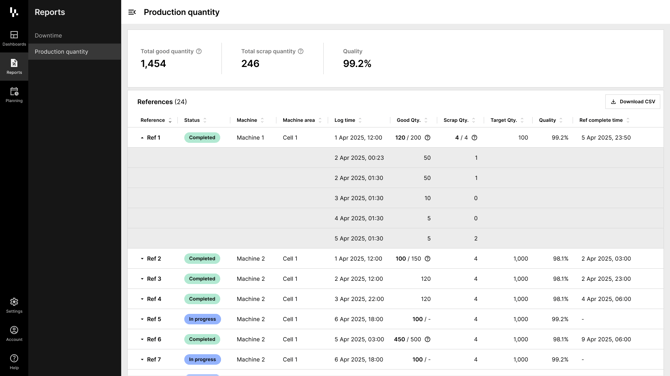
The Production Quantity report shows quality data broken down by reference, machine, and machine area — giving you the Quality component of your OEE in one place
Configuring your dashboard
You can customise any FourJaw dashboard to display the Uptime widgets that matter most to your operation. Use the Edit widget panel to filter by date range, shift, and display format — so your dashboard always shows the Availability view you need.